
Ncho'o Azabache

Ncho'o Azabache

Ncho'o Azabache (Vanessa Carrera Navarro)
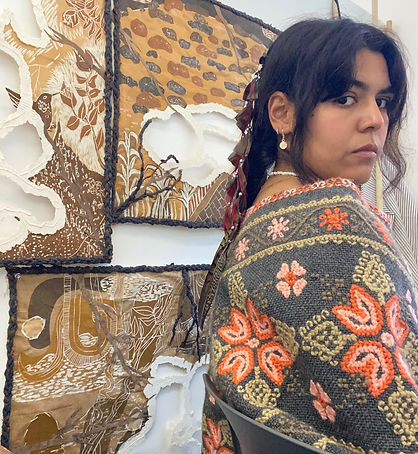
Artist's statement:
Ncho’o Azabache (she/her) is a printmaker/artist whose work celebrates and reclaims her Ñuu’savi heritage, and denounces the unethical practices of national and international museums and galleries in their refusal to return cultural objects to their communities of origin. She works with paper and fabric and incorporates Ñuu'savi (People of the Rain) symbols from pre-colonial codices created in the southeastern region of Mexico to decolonize her way of thinking about the life and the way she exists in the world.
When Azabache talks about reclaiming her identity as a Ñuu’savi ña’an (woman), she engages in archival research of her homeland (Izucar de Matamoros, Puebla) to understand her cultural history and represents herself through a hummingbird and rain, because this bird and natural element have a very profound and sacred meaning in the lower Mixtec region between the state of Puebla and Oaxaca, Mexico. Ncho'o in the Tu'un savi language means hummingbird which is also the chosen name by the artist. She believes it's even important to decolonize her birth name in order to reclaim what has been taken away from her and her ancerstors by the consequences of colonization.
Additionally, she celebrates her birthplace's Mixtec culture and traditions through the image of el arbol de la vida (tree of life), food and places. The tree of life is a local made polychrome ceramic piece, very representative of Izucar de Matamoros where each piece tells a story about whatever the artist wants to communicate.
Furthermore, Izucar de Matamoros is always represented in her work as the number seven and through its Mixtec symbol, which is an obsidian knife with teeth and black footprints. It's represented in a series of seven artworks, seven colors or even seven hummingbirds, because Izucar has fourteen neighborhoods with strong Mixtec traditions and they are always devided in half(7) during local parades.
In contrast of the celebration of her heritage, Azabache investigates the dark history of the looting of Mexican archeological artifacts. She is on a mission to reimagine a different future where these stolen pieces exist in a different context throught her printmaking practice. For her it's important to denounce this problem through her artwork, because only by returning these pieces to their communities in Mexico, will they be able to fully understand their cultural heritage and their past, and be free to live a life based on believes and values other than those introduced by the colonizers.
In addition to her practice, for Azabache returning to Mexico every summer has a profound impact on her work, research and her exploration on materials. To create, she returns home to her family every summer. Her father drives her to small towns around Izúcar de Matamoros to show her the authenticity of her culture. He takes her to hills filled with history from her ancestors to rivers and lagoons. This connects her with local community